What is Western Esotericism?
More and more people are calling themselves Western Esotericists. But what is Western Esotericism?
By Joe Rezendes
Esotericism is the state or quality of being esoteric. Generally, in the occult community, when somebody refers to something as being esoteric, they are talking about an occult science that’s veiled in allegories and symbols, that is intended for only a select few to understand, and has several different layers of meaning. It’s antonym, exoteric is the surface level message that is in plain view.
If you’ve ever taken a literary English class, you’re probably already familiar with this. Authors will convey messages and ideas through metaphors and symbols. For instance, an Author might decide to make something the color black, in order to associate it with the astrological properties of Saturn. Upon looking for the hidden meaning behind symbols, a problem arises. It’s hard to tell what’s intentional and what isn’t.
In other words, sometimes the curtains are red not for any symbolical meaning, but are red just because the author wanted them to be red. It’s because of this that the aspiring occult student faces a daunting task. This task involves the constant pursuit of trying to figuring out what the intended messages are in ancient mythology and mysticism.
It can be a difficult pursuit trying to figure out what’s esoteric and what is not. Luckily for us, the Western Mystery Tradition’s most prominent philosophers have paved the path for us.
With aid of hermeticism, qabbalah, and other occult philosophical concepts, we are able to decipher hidden meanings from ancient mythology and mysticism.
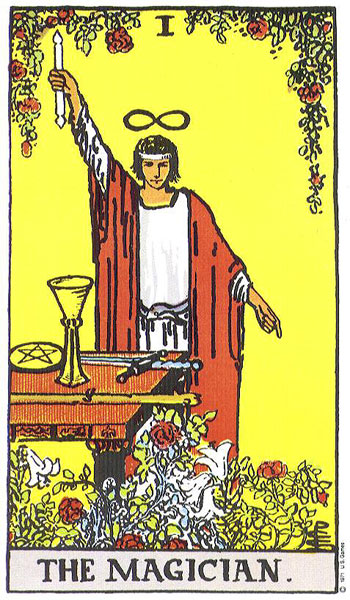
The Magician Tarot Card depicts the Hermetic Axiom:
As Above, So Below, which comes from the Emerald Tablet.
Hermeticism is a religious, philosophical, and esoteric tradition based primarily upon writings attributed to Hermes Trismegistus(Thrice Great). These writings have greatly influenced the Western Esoteric tradition and were considered to be of great importance during both the Renaissance and the Reformation eras.
Hermes Trismegistus is thrice great because he is the founder of the three parts of wisdom: Alchemy, Astrology, and Magic. His contributions to Alchemy have turned into modern medicine, and astrology into modern astronomy.
Many modern day Hermeticists are introduced to Hermeticism by the Kybalion, written by Three Initiates. This text is quite popular among beginning students and new age enthusiasts. Developed Hermeticists tend to have an awkward relationship with the Kybalion because it dumbs down much of the Science and presents it’s material in a very “Feel Good” way. It’s also not an original hermetic text.
It is however, important to mention the Kybalion, because it introduced to the masses, seven basic hermetic principles. These are said to have been taken from study of Hermes’s original teachings. While not all hermeticists accept these 7 principles, they are still important to know about.
The bulk of Hermetic Sciences are found in Hermes Trismegistus’s books: The Emerald Tablet, Corpus Hermeticum, The Divine Pymander, The Virgin of the World, and other such works.
Using these Hermetic sciences, the study of magic was born, and today many Secret Socieites are devoted to the study of Hermeticism. Groups such as the Hermetic Order of the Golden Dawn, Ordo Templi Orientis, AMORC, and many others all share this system of thought.
Rosicrucianism came about in the 17th century after several texts announced the existence of an unknown esoteric order. Because Rosicrucianism was brought into the limelight around the same time as FreeMasonry, many believe that the two influenced each other. The mysterious doctrine of the original Rosicrucian Order was allegedly “built on esoteric truths of the ancient past”, which “concealed from the average man, provide insight into nature, the physical universe and the spiritual realm.” The manifestos do not elaborate extensively on the matter, but clearly combine references to Kabbalah, Hermeticism, and mystical Christianity.
Hermetic Qabalah (from the Hebrew קַבָּלָה “reception” or “accounting”) is a Western esoteric tradition involving mysticism, Gnosticism, and the occult. It is the underlying philosophy and framework for magical societies such as the Golden Dawn, Thelemic orders, mystical-religious societies such as the Builders of the Adytum and the Fellowship of the Rosy Cross, and is a precursor to the Neopagan, Wiccan and New Age movements.
Occult Hermetic Qabalah arose alongside and united with the Christian Cabalistic involvement in the European Renaissance, becoming variously Esoteric Christian, non-Christian, or anti-Christian across its different schools in the modern era.
It draws on a great many influences, most notably: Jewish Kabbalah, Western astrology, Alchemy, pagan religions, especially Egyptian and Greco-Roman (it is from the latter that the term “Hermetic” is derived), neoplatonism, gnosticism, the Enochian system of angelic magic of John Dee and Edward Kelley, hermeticism, tantra and the symbolism of the tarot.
Hermetic Qabalah differs from the Jewish form in being a more admittedly syncretic system, however it shares many concepts with Jewish Kabbalah.
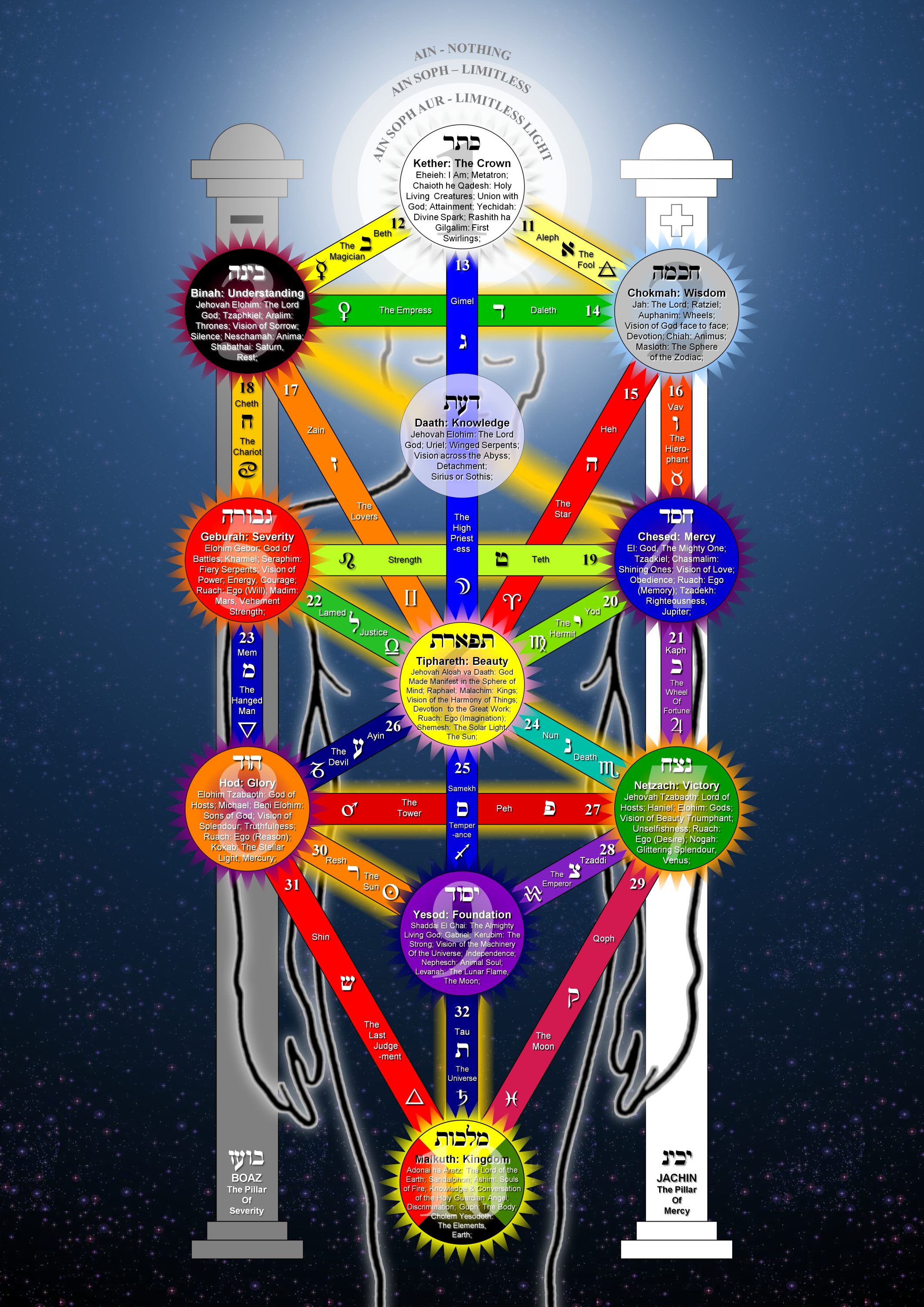
The Qabalistic Tree of Life is depicted above.
This specific depiction combines hermetic, rosicrucian,
and masonic symbolism with the original Kabalistic diagram.
Kabalah, Qabalah, Cabala, why so many different spellings? Since Kabalah is used in so many different spiritual systems in different ways, we distinguish how it’s used by the first letter it’s spelt with. A ‘K’ is indicative of the Jewish practice, a ‘C’ for the Christian, and a ‘Q’ for the occult and hermetic practice.
The tree of life is divided into 10 different spheres called Sephiroth, with a hidden eleventh sephiroth called Da’ath which is normally not depicted. The Tree of Life is a map of the Universe. The Tree of Life is another great example of the Macrocasm and Microcasm, and teaches us that by studying that which is above, we can learn about that which is below, and vice versa.
Gemetria a alphanumeric cipher with the belief that words or phrases with identical numerical values bear some relation to each other or bear some relation to the number itself. In Hebrew, each letter also has a numerical value.
When Hebrew words are reduced to their numerical values, we find that quite often different words or phrases that are related to each other share the same numerical value. This is also why Qabalah in Hebrew translates to accounting.
The last component of the Western Esoteric Tradition is the study of magic. The magic of Western Esotericism is known as ceremonial magick.
Ceremonial magic or ritual magic, also referred to as high magicand as learned magic in some cases, is a broad term used in the context of Hermeticism or Western esotericism to encompass a wide variety of long, elaborate, and complex rituals of magic.
It is named as such because the works included are characterized by ceremony and a myriad of necessary accessories to aid the practitioner. It can be seen as an extension of ritual magic, and in most cases synonymous with it.
Popularized by the Hermetic Order of the Golden Dawn, it draws on such schools of philosophical and occult thought as HermeticQabalah, Enochian magic, Thelema, and the magic of various grimoires.
Ceremonial Magic differs from Witchcraft in many different ways. The first of which is that most practitioners of Witchcraft are not well versed in the Western Esoteric Tradition, and many have never heard of it’s existence.
Witchcraft doesn’t require a strong basis of philosophical and occult philosophy to preform either. Moreover, most Ceremonial Magicians have a degree of skepticism in their practice. Generally speaking, the Ceremonial Magician is more concerned in the pursuit of hidden knowledge and the scientific explanations for why things occur than those that practice Witchcraft.
The areas of study that make up Western Esotericsm are each worth a lifetime of study by themselves.
There’s such a large depth of material in this strange world that it’s difficult to figure out where to begin. I’m hopeful that you may have discovered a specific key term that’s of interest to you, and that this will be the start of a lifelong pursuit of hidden esoteric knowledge. If you are interested in learning more, consider joining our private Facebook group.
Featured Posts
What is Western Esotericism?
More and more people are calling themselves Western Esotericists. But what is Western Esotericism?
The Problem With Open Occult Communities
Many Occultists are turned off by open online Occult Communities for several reasons. Why is there so much fluff?